La Spezia is located in the homonymous “Gulf of La Spezia”, known as the “Gulf of poets”, with Portovenere and its islands in the west, with the territory of Tramonti that goes as far as the “Cinque Terre”, while to the east we find Lerici and its wonderful castle.
Portovenere is a seaside village consisting of a series of houses aligned on the Doria calata, almost forming a medieval fortress and in front of the village we find its three islands: Palmaria, Tino and Tinetto.Lerici instead is a village of Roman origins famous for its its medieval castle and is now also home to a paleontological museum.
The Cinque Terre
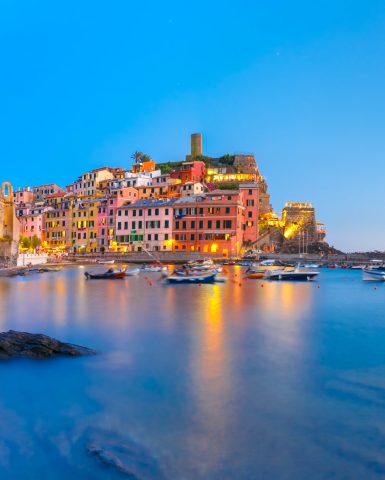
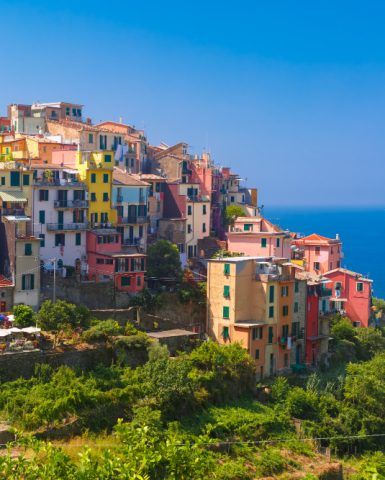
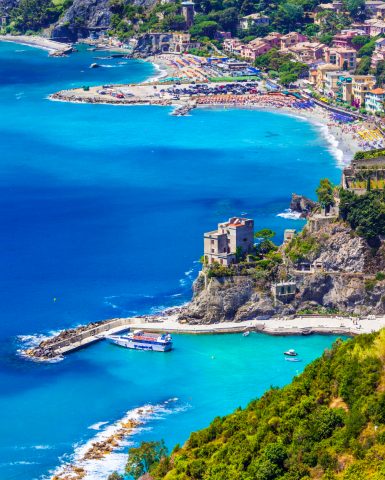
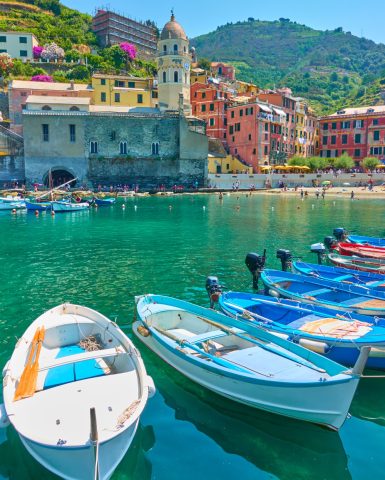
From La Spezia it is possible to reach the “Cinque Terre” (either by train using the Trenitalia ‘5 Terre Express’ card, or by boat), 5 beautiful villages set among rocks and small inlets. They have been declared a World Heritage Site by Unesco and are made up of: Monterosso, Vernazza, Corniglia, Manarola and Riomaggiore.
Monterosso
Monterosso is the most famous seaside destination and also the largest village; it is divided in two sides by a tunnel that separates the historic center from the residential area and the station, called “Fegina”.
From here starts a path with a wonderful view that in about an hour’s walk leads to Punta Mesco and then in another hour and a half to Levanto.
Other famous places to see in Monterosso are the parish church of San Giovanni Battista (dating back to 1282), the church of San Francesco annexed to the Capuchin Convent, the statue of the Giant and on the hills 418 meters above sea level, the sanctuary of Nostra Signora di Soviore, a sanctuary of Romanesque origins.
Vernazza, Corniglia and Manarola
Vernazza consists of steep streets that run towards the main square that overlooks a small harbor and a small bay in which the church dedicated to St. Margaret of Antioch is reflected. Do not forget the Doria castle.
Corniglia is the center of the Cinque Terre, stands on a rocky promontory about 100 meters high, famous for its paths overlooking the sea that offer a breathtaking view.
Finally, Manarola, a medieval village perched on a rock, famous for the Via dell ‘Amore that connects it to Riomaggiore, has only partially reopened today. To remember are also the bell tower and the parish church of San Lorenzo.
Riomaggiore
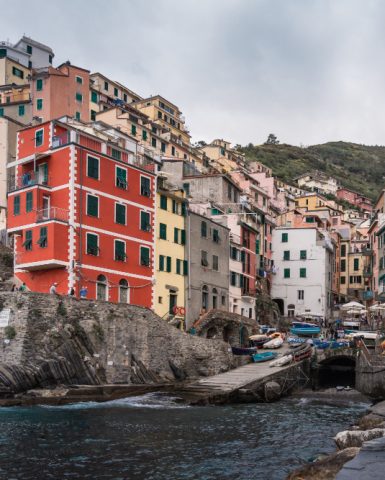
Major stream and its colorful tower-shaped houses seem to rise from the sea to embrace the hills. It is famous for “La Via dell’Amore”, a path that leads to Manarola, and for its fantastic views.
Not to be forgotten are the churches of San Giovanni Battista and San Lorenzo, dating back to 1300, and the Castle built in 1260 perched on a rock from which you can enjoy an enchanting view.
La Spezia
The city can be easily visited on foot or by taking the tourist train that leaves from the cruise terminal, a stone’s throw from the apartment.
There are also numerous cycle paths and bike sharing stations, as well as the stairways that allow you to reach the hilly arc of the city, from which various paths depart that allow you to explore the hinterland.
Strolling by the sea we find the Morin promenade that ends at the Ravel quay (from which boats leave for Portovenere, the Cinque Terre, Portofino and the Palmaria island) from which it is possible to visit the “Tahon di Revel” bridge which ends directly at Porto Mirabello. .
Coming back to the historic center of the city we find Piazza Europa which leads us to Piazza Verdi, (overlooked by the “Palazzo degli Studi” and the “Palazzo delle Poste”) which leads us to Piazza Sant’Agostino, the heart of the historic center, from which several stairways start to reach the castle of S. Giorgio (it is also possible to reach it by lift from via del Prione).
The historic center
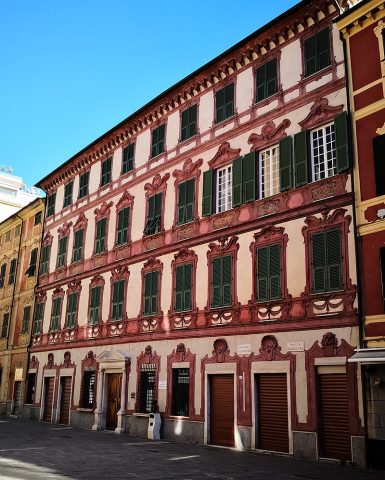
The historic center of La Spezia can also be reached starting from the station, through via Paleocapa and Piazza Brin, home to several Art Nouveau buildings.
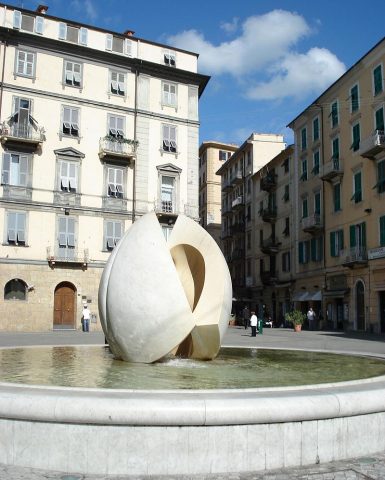
Continuing we find Piazza Garibaldi, in the center of which we find the modern “Fountain of Dialogue” and from here starts via del Prione, a historic street full of shops and refreshment points that reaches the seafront.
Going down via del Prione, if we turn left into via Indipendenza, we find the lift that takes us to the castle, home to the Civic Archaeological collections, from whose terrace you can enjoy a priceless view.
On the opposite side of via Indipendenza it is possible to reach via Biassa which takes us to piazza Beverini, where we find the church dedicated to S. Maria Assunta. The square is bordered by Corso Cavour, a famous shopping street.
Last but not least, we remember via Chiodo with its arcades, which starts from Piazza Verdi and reaches the military arsenal, where we find the naval technical museum of the “Navy”. In a few steps you can reach Piazza Cesare Battisti, where the CAMec, “Center for modern and contemporary art” is located.